BATON ROUGE PERSONAL INJURY LAWYER
Types of Truck Accidents
100% Committed To Maximizing Your Recovery
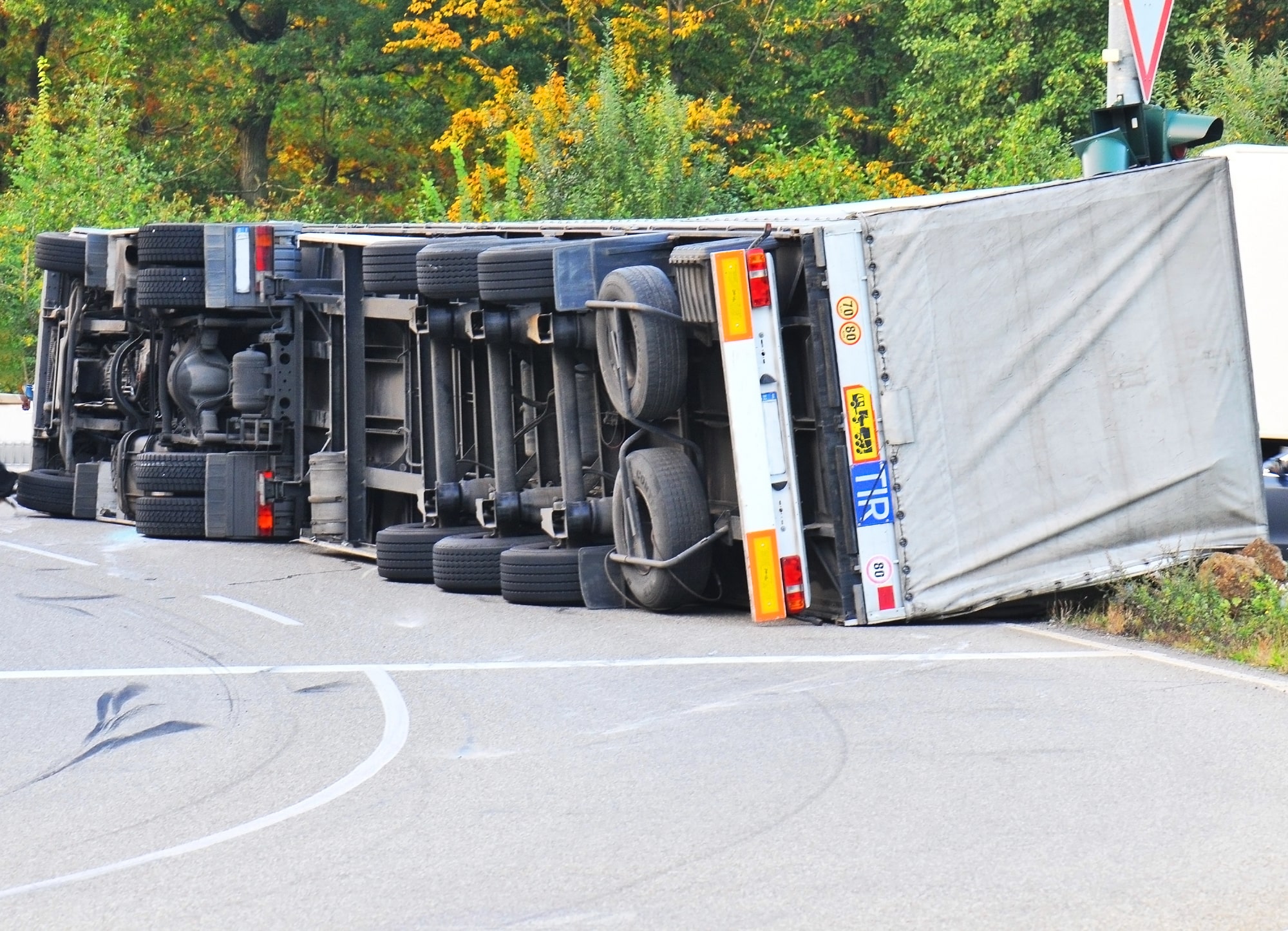
Commercial vehicles fail in patterns. A tractor-trailer does not simply crash; it jackknifes, rolls, underrides, or sheds its load, and each of those events has its own physics and its own evidence trail. Knowing which type occurred tells you a great deal about what went wrong and who is likely responsible. Our overview of the most common truck accidents covers the basics; this page examines the mechanics behind each.
Jackknife Accidents
A jackknife occurs when the trailer swings out from the tractor, folding the rig toward a right angle. It typically follows hard braking, particularly on wet or icy pavement or during a descent, when the trailer’s momentum overcomes the traction holding it in line.
Contributing factors include brake imbalance between tractor and trailer, worn tires, an empty or lightly loaded trailer with reduced traction, and speed unsuited to conditions. Jackknifes frequently block multiple lanes, which is why they so often become multi-vehicle events on busy corridors like I-70 and I-71 through Ohio.
Underride Collisions
Underride crashes occur when a passenger vehicle slides beneath a trailer. Because the trailer sits above a car’s bumper and crumple zone, the safety structures that would normally protect occupants never engage, and the trailer can enter the passenger compartment directly. These are among the most lethal crash types on the road.
Rear underride is the type federal regulators have addressed most directly. NHTSA finalized a rule in July 2022 upgrading the standards for rear impact guards on trailers and semitrailers, requiring guards capable of protecting occupants in a 35 mph impact and establishing a federal advisory committee to study side underride protection. Side underride remains largely unregulated.
In litigation, these cases turn on whether the guard was present, compliant, and properly maintained, and whether trailer conspicuity tape was intact and visible.
Rollovers
Rollovers usually result from a combination of speed, a high center of gravity, and lateral force. Highway ramps are the classic setting, since a curve rated for passenger cars may be well beyond a loaded trailer’s stability threshold.
Load distribution matters as much as speed. Improperly distributed freight, unsecured cargo that shifts mid-turn, and liquid surge in partially filled tanks all destabilize a rig. On sustained mountain descents, the same forces compound with brake fade, which is why runaway truck ramps exist along routes like I-70 west of Denver in Colorado.
Rear-End and Following Distance Crashes
A loaded tractor-trailer requires substantially more stopping distance than a passenger car. When a driver follows too closely, is distracted, or is fatigued, that margin disappears.
Engine control module data is decisive here, capturing speed, throttle position, and whether the brakes were applied at all in the seconds before impact.
Wide Turn and Squeeze Accidents
Tractor-trailers frequently swing left before completing a right turn. A vehicle occupying the gap can be crushed against the curb or caught beneath the trailer as it tracks inward.
These crashes cluster in dense urban environments with tight intersections and heavy delivery traffic, which makes them a persistent problem in metropolitan areas across New York.
Blind Spot and Lane Change Collisions
Commercial vehicles have substantial blind zones along both sides, directly in front, and well behind the trailer. Drivers are trained to check them; the duty to do so before changing lanes rests with the truck. Mirror adjustment records, dashcam footage, and any installed proximity systems become relevant.
Tire Failures and Road Debris
A blowout at highway speed can pull a rig across lanes, and separated tread becomes a hazard for everyone behind. A detached wheel is worse still, capable of causing catastrophic damage well away from the truck, as our report on a loose truck tire sending a car airborne illustrates.
These cases turn on maintenance records, tire age and tread depth, retread history, and inflation practices, and they sometimes reach the tire manufacturer as a product claim.
Cargo Spills and Hazardous Materials
Spilled freight creates a secondary hazard for every vehicle in the area. When the cargo is flammable or toxic, the consequences escalate dramatically, and tanker fires can produce fatalities well beyond the initial collision, as our coverage of a tank truck fire in Texas shows.
Hazmat carriers face additional placarding, routing, training, and emergency response duties, along with substantially higher federal insurance minimums. Petrochemical corridors carry heavy concentrations of this traffic, including the I-10 route through Louisiana and freight moving across Texas.
Head-On and Lane Departure Crashes
Crossing a centerline or median produces the highest-severity outcomes because closing speeds combine. Fatigue, impairment, medical events, and steering or tire failure are the usual explanations. Logs, testing records, medical certification files, and mechanical inspection results are where the answer lies.
Why Crash Type Guides the Investigation
An underride case examines the guard and the trailer. A rollover case examines loading and route. A tire case examines maintenance and possibly the manufacturer. A jackknife case examines brakes and conditions. Identifying the type early determines what must be preserved before it disappears.
Talk to a Truck Accident Attorney
The physical evidence that establishes crash type, including the tractor, the trailer, the failed component, and the roadway itself, is often released or repaired within weeks. An attorney can arrange inspection before that happens. Consultations are free and these cases are handled on contingency, so there is no fee unless you recover. Contact us to have your case reviewed.